Signs You Need Duct Cleaning in South Florida
In Hollywood, Broward, and Miami-Dade, summer air stays warm and humid for months. The National Weather Service in Miami describes southeast Florida’s summer that way, with dew points in the lower to middle 70s. Using Miami International Airport records, that office put the median start of summer at May 21 and the median end at October 17. Winter, in the same description, is cooler and less humid. A long humid season is not the same thing as a dirty duct system.
The U.S. Environmental Protection Agency does not recommend routine air duct cleaning. It says cleaning has never been shown to prevent health problems, and that a light amount of household dust in ducts has not been shown to pose a health risk. Cleaning is worth a look when there is a specific problem: substantial visible mold, pests, or ducts clogged with heavy dust and debris.
How humidity reaches the ducts
Mold needs water. The EPA’s mold guide says mold will not grow indoors without moisture, and that the way to control mold is to control moisture. Dry wet materials within 24 to 48 hours. If you can, keep indoor relative humidity below 60 percent, ideally between 30 and 50 percent. A humidity meter can read that number.
The same guide lists air conditioners and dehumidifiers as ways to lower indoor humidity when you need them. Running the air conditioner through that humid season is normal. It is not, by itself, a sign the ducts are contaminated.
Moisture can still get into the ducts. The EPA’s duct-cleaning guide says moisture should not be present in ducts, and that controlling moisture is the most effective way to prevent biological growth there. It points to condensation on or near the cooling coil as a major way moisture enters the system. An air conditioner that is too large for the house is a related problem in humid areas: it switches on and off quickly and removes moisture poorly. Standing water or debris in the condensate pan needs attention.
That is a moisture problem. It does not mean every system in Hollywood or Miami-Dade is moldy.
What you can see without opening the system
You cannot see most of the duct run from a hallway. The EPA notes that many sections of a heating and cooling system are not open to a visual check, and says to ask a service provider to show you any mold they say is there. Start with the parts you can reach.
Dust on the grille
A dusty return grille is normal. Dusty room air is pulled through that grate. The EPA says that film does not mean the ducts are packed with debris. Vacuum the grille, or take it down and clean it.
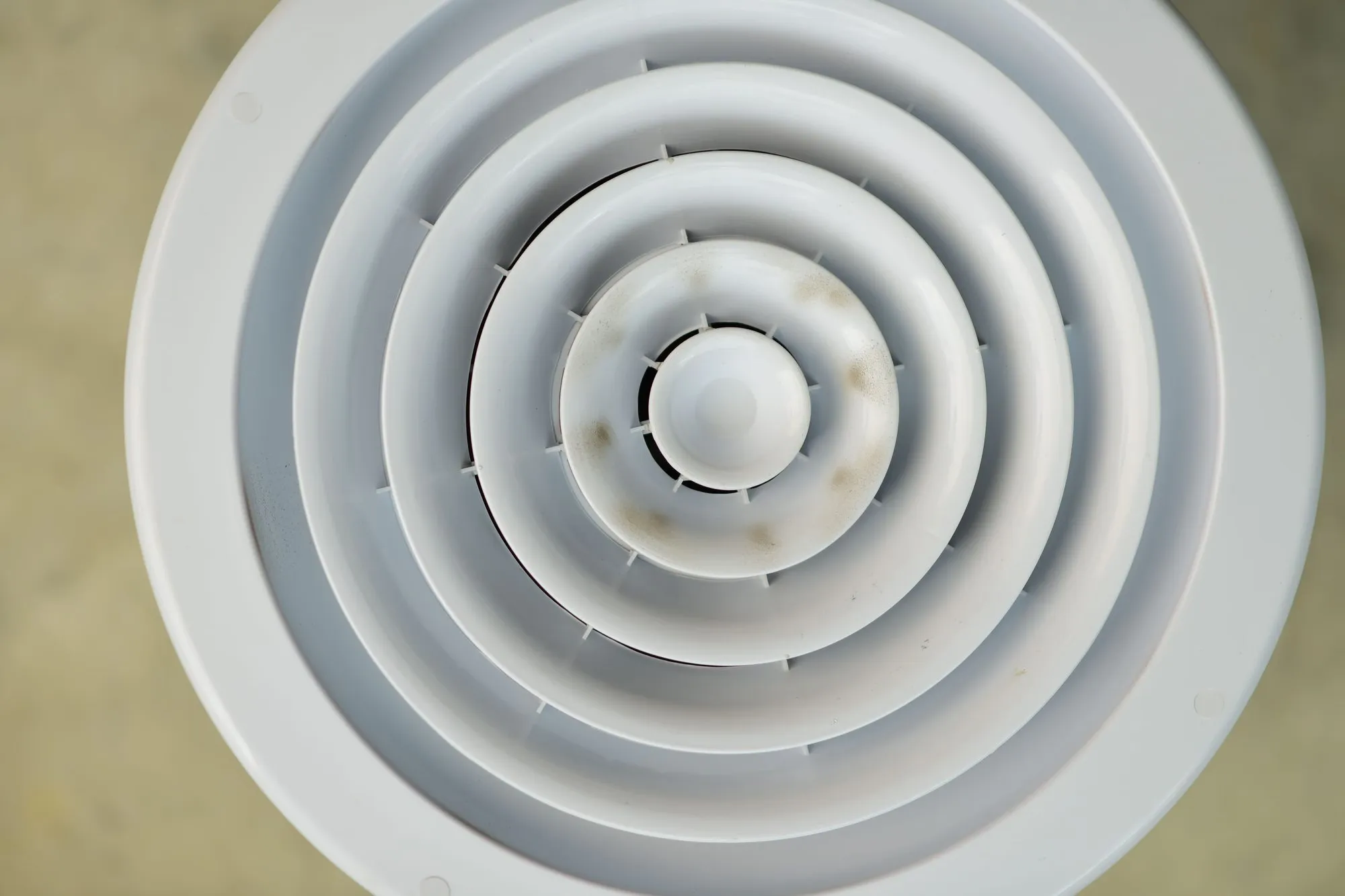
Light dust and discoloration on the rings of a round ceiling diffuser, like the photo at the top of this page, are the same kind of surface film. You can wipe that. It is not, by itself, a reason to clean the whole system.
Debris that is leaving the ducts
The decision changes if the ducts you can see are clogged with heavy dust and debris, or if particles are actually blowing out of the supply registers into the room. The EPA lists both as reasons to consider cleaning.
Smell, stains, and spots that might be mold
A musty odor, or visible growth inside a duct or on another part of the system, is the other finding the EPA tells you to take seriously. If you look and you do not see large deposits of dust or mold, and there is no musty odor, the EPA says cleaning is probably unnecessary when no one in the home has allergies or unexplained symptoms or illness.
Those symptoms are a reason to talk with a doctor. They are not, on their own, a reason to clean the ducts, and cleaning is not a treatment for allergies.
Color is not an identification. The EPA says a substance can look like mold, and that only an expert can determine whether it is mold. A laboratory may be needed to confirm it. A professional or a lab has to confirm the type. Do not name it from a photo or from a dark ring on a diffuser.
If you know or suspect the system is contaminated with mold, the EPA’s mold guide says not to run it. Running it can spread mold through the building. Fix the water first. If the cause stays, growth comes back. Wet or moldy fiberglass duct liner cannot be cleaned effectively and should be removed and replaced.
Pests
Rodents or insects in the ducts are their own reason to clean, on the EPA’s list. Droppings, nesting material, or insects at a register are worth a closer look. A dusty grille is not the same finding.
When cleaning is warranted
Consider air duct cleaning when one of these is true:
- There is substantial visible mold growth inside hard-surface ducts, or on other parts of the heating and cooling system
- Ducts are infested with rodents or insects
- Ducts are clogged with excessive dust and debris, or particles are being released into the home from the supply registers
When cleaning is not warranted
Skip a full cleaning when the only finding is ordinary dust on the grilles, and when no one can show you mold, pests, or heavy debris inside the system.
The EPA does not recommend a routine schedule, because knowledge of the benefits and possible problems is limited. Studies also do not conclusively show that particle levels in homes go up because ducts are dirty, or go down after a cleaning. Much of that dirt sticks to the duct wall. Cooking, cleaning, outdoor air, and moving around can expose you to more particles than a dusty duct does.
Do not hire a cleaner who makes sweeping claims about health benefits. The EPA says those claims are unsubstantiated.
What to do next
Measure indoor humidity and aim for under 60 percent, ideally 30 to 50 percent. Dry wet spots within 24 to 48 hours. Use the highest-efficiency filter the system manufacturer recommends, and change it before it clogs. Make sure air cannot leak around the filter. If you can safely see the condensate pan, standing water or debris in it needs to be fixed.
If you find substantial visible growth, pests, or ducts packed with debris, the next step is an inspection. Happy Ducts provides air duct cleaning for homes in Hollywood and across Miami-Dade, Broward, and Palm Beach counties. See the Hollywood location for the Hayes St address, or air duct cleaning in Miami. Hollywood hours are 8 AM to 9 PM daily.
Call 833-442-7792 or request a quote. Ask to be shown anything someone says is inside the ducts. If it might be mold, a professional or a lab has to confirm the type before anyone treats a stain as a named mold. When cleaning is warranted, it comes after the moisture or the pest problem is fixed.
Get Your Free
Estimate Today
Call us today and get your free estimate, no
strings attached.